This post was originally published on here
NEWPORT NEWS — The U.S. Department of Energy’s Thomas Jefferson National Accelerator Facility is moving forward with a major renovation that will transform the Applied Research Center into a hub of science, education and collaboration, Jefferson Lab announced.
This follows the 2023 acquisition of the ARC from the City of Newport News.
The CEBAF Renovation and Expansion project marks a significant milestone as Jefferson Lab’s first project to receive delegated authority from the Department of Energy, it said. This designation streamlines reviews, shortens approval processes and expedites construction projects, allowing national labs to move forward more efficiently. For Jefferson Lab, this has already reduced approval times, expediting the timeline from design approval to construction start, it said.
“This delegated authority represents a new era of efficiency for our lab,” said Jefferson Lab Conventional Facilities Project Manager Corry Smith, who oversees the CRE project. “We have grown so much over the last few years, and with that growth comes a need for more space.”
Jefferson Lab said the project exemplifies strong collaboration between it, the DOE, and the City of Newport News, whose Economic Development Authority donated the 122,000-square-foot building to help alleviate the lab’s growing office space challenges.
“The City of Newport News’ donation of the ARC building has been essential to meeting our lab’s growing mission,” said Jefferson Lab Director Jens Dilling. “Thanks to this partnership and the DOE’s delegated authority process, we’re able to modernize our infrastructure to match our scientific excellence and ambitions. This renovated facility will become a center of collaboration that connects our scientists, university partners and the community in meaningful ways.”
Originally built in 1996 by the city, the ARC has operated as a leased space for the lab and local university research departments since its opening in May 1998. Featuring a mix of open-concept and private workspaces, Jefferson Lab said the ARC’s reconfigured floor plan will promote close collaboration with 122 office spaces and 15 conference areas.
Additional classrooms will exist for the lab’s STEM Workforce Development Office, the department that leads the lab’s efforts in mentoring future leaders in science, technology, engineering and mathematics.
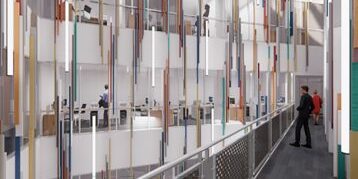
The architectural plan also includes enhancements to existing areas, such as the prism-shaped atrium that allows natural daylight into the building, according to the lab.
Inspired by the lab’s electron beam accelerator, designers have created an art installation using colored aluminum tubes and transparent resin that will mimic a particle accelerator while soundproofing the space.
The renovation also presents an opportunity to upgrade outdated mechanical systems, the lab said, including a new geothermal heating, ventilation and air conditioning system that will replace the existing one.
“The geothermal HVAC is an important new technology because it’s economical and reliable,” said Smith.
Geothermal HVAC regulates building temperature using heat continuously produced beneath the Earth’s surface.
Relocating employees to the now DOE-owned ARC has long been a strategic priority. A majority of the lab’s operations groups currently work in the Support Service Center building. Teams that support functions such as human resources, communications, facilities management and STEM workforce development will relocate to the ARC.
The entire CRE is budgeted at $90.3 million and is funded by the DOE. This funding amount covers everything from design and construction to project management costs.
The renovations are planned to take 19 months. The broader CRE project also includes potential renovations to the lab’s main administration building, CEBAF Center, with the full project is expected to conclude by early 2031, the lab said.
This project demonstrates the power of delegated authority in action,” said Jefferson Lab Manager of Conventional Facilities Project Management and CRE Project Director Brian Hill. “We’re modernizing a 122,000-square-foot facility with advanced technology, new collaborative spaces and educational amenities, all while moving faster and more efficiently than traditional federal processes would allow.”