
This post was originally published on here
Here’s all the latest local and international news concerning climate change for the week of Jan. 12 to Jan. 18, 2026.
Article content
Here’s the latest news concerning climate change and biodiversity loss in B.C. and around the world, from the steps leaders are taking to address the problems, to all the up-to-date science.
Advertisement 2
Story continues below

Article content
Check back every Saturday for more climate and environmental news or sign up for our Sunrise newsletter HERE.
Article content
Article content
In climate news this week:
• Coastal First Nations hold firm on opposition to bitumen pipeline during meeting with Carney
• Scientists confirm 2025 was third-hottest year, trailing 2024 and 2023
• December floods in B.C. caused nearly $90 million in insured damage
Human activities like burning fossil fuels and farming livestock are the main drivers of climate change, according to the UN’s intergovernmental panel on climate change. This causes heat-trapping greenhouse gas levels in Earth’s atmosphere, increasing the planet’s surface temperature.
The panel, which is made up of scientists from around the world, including researchers from B.C., has warned for decades that wildfires and severe weather, such as the province’s deadly heat dome and catastrophic flooding in 2021, would become more frequent and intense because of the climate emergency. It has issued a code red for humanity and warns the window to limit warming to 1.5 C above pre-industrial times is closing.
Advertisement 3
Story continues below
Article content
According to NASA climate scientists, human activities have raised the atmosphere’s carbon dioxide content by 50 per cent in less than 200 years, and “there is unequivocal evidence that Earth is warming at an unprecedented rate.”
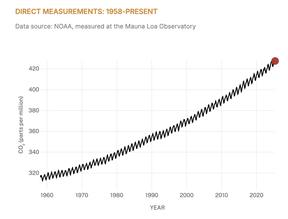
As of Jan 5, carbon dioxide in the atmosphere was 427.49 parts per million, up slightly from 426.46 ppm the previous month, according to the latest available data from the NOAA measured at the Mauna Loa Observatory, a global atmosphere monitoring lab in Hawaii.
The NOAA notes there has been a steady rise in CO2 from under 320 ppm in 1960.
Quick facts:
• The global average temperature in 2023 reached 1.48 C higher than the pre-industrial average, according to the EU’s Copernicus Climate Change Service. In 2024, it breached the 1.5 C threshold at 1.55 C.
• 2025 was the third warmest on record after 2024 and 2023, capping the 11th consecutive warmest years.
• Human activities have raised atmospheric concentrations of CO2 by nearly 49 per cent above pre-industrial levels starting in 1850.
• The world is not on track to meet the Paris Agreement target to keep global temperature from exceeding 1.5 C above pre-industrial levels, the upper limit to avoid the worst fallout from climate change including sea level rise, and more intense drought, heat waves and wildfires.
• UNEP’s 2025 Emissions Gap Report, released in early December, shows that even if countries meet emissions targets, global temperatures could still rise by 2.3 C to 2.5 C this century.
• In June 2025, global concentrations of carbon dioxide exceeded 430 parts per million, a record high.
• There is global scientific consensus that the climate is warming and that humans are the cause.

Canucks Report
Article content
Advertisement 4
Story continues below
Article content
(Sources: United Nations IPCC, World Meteorological Organization, UNEP’s 2025 emissions gap report, NASA, Copernicus Climate Change Service, climatedata.ca)
Latest News
Coastal First Nations hold firm on opposition to bitumen pipeline during meeting with Carney
Coastal First Nations leaders viewed Tuesday’s meeting with Prime Minister Mark Carney in Prince Rupert as a respectful start to building a relationship with government on advancing economic development in the northwest, but they were clear in their opposition to a new bitumen pipeline in the region.
“Coastal First Nations, along with the Lax Kw’alaams and the Haisla Nation oppose any project that proposes to bring oil tankers to the North Coast,” said Marilyn Slett, president of the Coastal First Nations group and chief councillor of the Heiltsuk Nation.
“We reiterated that there is no technology that can clean up an oil spill at sea, and that it would take just one spill to destroy our way of life,” she told reporters following the meeting.
Advertisement 5
Story continues below
Article content
Carney travelled to Prince Rupert at the invitation of the Coastal First Nations and, in a clip from a Global News report, said the occasion was “not a day for big announcements, (but) for dialogue, for listening and working.”
The potential for a new pipeline being pushed by Alberta Premier Danielle Smith as a “nation-building project” to diversify Canada’s oil exports formed the backdrop for Tuesday’s meeting. Coastal First Nations were angered at being excluded from discussions about the possibility of building one.
—Derrick Penner
Scientists confirm 2025 was third-hottest year, trailing 2024 and 2023
Last year was the third hottest on record, according to an analysis of temperature data released Wednesday by three independent agencies. That puts 2025 just behind the second-hottest year, 2023, and the hottest, 2024.
What makes this result extraordinary, scientists say, is that 2025 saw a cooling phase in the equatorial Pacific Ocean, or La Niña, that suppresses global temperatures. In other words: Heat from greenhouse gases countered that cooling influence enough that the year still landed among the very warmest.
Advertisement 6
Story continues below
Article content
It’s more evidence that “human-caused warming is now really overwhelming inter-annual natural variability” in weather, said Daniel Swain, a climate scientist in the University of California’s Agriculture and Natural Resources division.
The notable 2025 heat is in line with what many scientists say is a recent speeding up of the pace of global warming. “The warming spike observed from 2023-2025 has been extreme, and suggests an acceleration,” wrote researchers with Berkeley Earth, a scientific nonprofit that maintains one of the temperature databases.
Several factors are likely contributing to the acceleration, they wrote, including declines in reflective low-hanging clouds and in sulphur pollution from shipping that has a cooling effect.
—Bloomberg News
December floods in B.C. caused nearly $90 million in insured damage
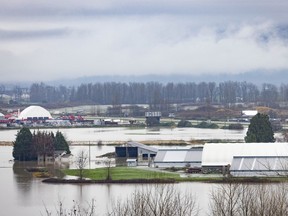
Severe rainstorms that led to flooding in December resulted in $90 million in insured damage, a warning that more funding needs to be invested in climate resiliency, the Insurance Bureau of Canada said Friday.
Advertisement 7
Story continues below
Article content
Record-breaking rains from huge plumes of moisture carried across the Pacific Ocean from tropical storms, called atmospheric rivers, resulted in the evacuation of hundreds of properties, damaged homes and farms, and shut down highways.
“Severe weather and flooding has once again disrupted the lives of residents and business owners across southwestern B.C. and Vancouver Island,” said Aaron Sutherland, vice-president of the Pacific and Western region for the Insurance Bureau of Canada.
“Coming just four years after the devastating 2021 floods, this most recent flood damage is a painful reminder of the need to build B.C.’s resilience and better protect communities from the new weather reality we face,” he said.
In the aftermath of the extreme, deadly flooding in B.C. in 2021, the province developed a flood strategy that included measures to better protect families and communities, but unfortunately, the strategy remains underfunded, warned the insurance bureau.
Advertisement 8
Story continues below
Article content
—Gordon Hoekstra
B.C. opens public review of Elkford coal mine expansion proposal
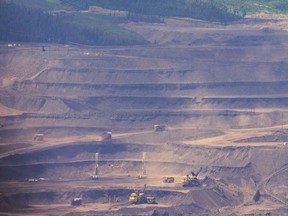
B.C. residents can now weigh in on whether a coal mine in southeastern B.C. should be allowed to proceed with plans to expand operations despite cross-border water pollution concerns.
Glencore-owned Elk Valley Resources, which operates four mines producing steelmaking coal, has renewed a proposal to extend Fording River operations for another 35 years. The company is also proposing to expand operations by mining in a new area just south of the existing mine, about 15 kilometres northeast of Elkford.
The proposed expansion of the mine — which would expand the mine by 20 square kilometres — entered B.C.’s environmental assessment process public comment period on Wednesday.
Those who want to comment can do so on the government’s EPIC engage website. The process runs from Wednesday to Feb. 15.
In November, the federal government said more work was needed to address cross-border water pollution risks to fish and fish habitat, migratory birds and the Indigenous.
Advertisement 9
Story continues below
Article content
—Tiffany Crawford
Data centres and coal helped drive up U.S. emissions in 2025
U.S. greenhouse gas emissions ticked higher last year following two years of declines, according to an estimate released Tuesday by the Rhodium Group, a research firm. They rose more than the country’s gross domestic product, reversing the earlier decoupling of emissions from economic growth.
The 2.4 per cent jump was driven by the buildings and power sectors, according to the new report. Colder winter temperatures increased demand for space heating, while data centres and cryptocurrency mining pushed electricity usage higher. Coal generation jumped 13 per cent last year compared to 2024 — the second time in the past decade that the fuel’s use increased in the U.S., reflecting higher natural gas prices.
Analysts said the finding underscores the need for more clean sources of power as demand goes up. To get emissions heading down again, “we need to see continued strong deployment of renewable resources and batteries in the power sector,” said Michael Gaffney, a Rhodium research analyst and one of the report’s authors.
Advertisement 10
Story continues below
Article content
The increased demand for heating drove up emissions from buildings by 56 million metric tons, or 6.8 per cent, according to the report. The power sector’s emissions rose by 3.8 per cent, reflecting higher electricity usage and more coal burning.
Globally, carbon dioxide emissions are estimated to have hit a record high in 2025.
—Bloomberg News
Baby Bigg’s killer whale spotted near Tofino is malnourished and injured, says researcher
A baby Bigg’s orca photographed travelling with T068C pod near Tonquin Beach off Tofino on Jan. 5 appears to be in poor health and will likely die, according to whale researcher Jared Towers.
Towers, executive director of Bay Cetology, said the transient orca calf is very skinny, very young and has an open wound on its dorsal fin.
“The thing that is really concerning is, if you look at the head, the head is really pronounced compared to the back,” Towers said. “
The calf isn’t nursing very well and not building fat reserves. It’s not far out from dying,” he said. “It’s nice to see it’s right close to mom though. It looks like mom is trying.”
—Nora O’Malley
I’m a breaking news reporter but I’m also interested in writing stories about health, the environment, climate change and sustainable living, including zero-waste goals. If you have a story idea related to any of these topics please send an email to [email protected]
Article content