This post was originally published on here
Mars is absolutely dripping with evidence that the red planet was once a striking blue, complete with glistening lakes, snaking rivers, and vast oceans. Now, scientists have calculated the ‘sea level’ during the wettest time known in Martian history.
Examining data from three satellites, scientists in Italy and Switzerland homed in on a canyon called Coprates Chasma – itself part of Valles Marineris, the largest canyon network in the Solar System.
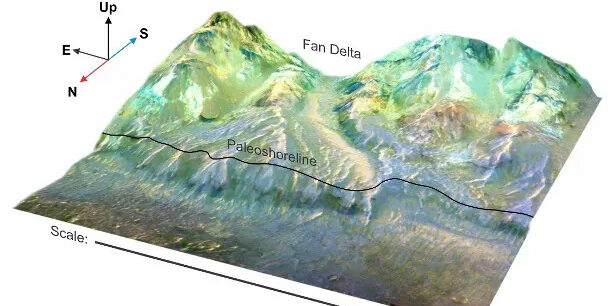
There, satellite images showed fan-shaped deposits that look suspiciously like the kind of river deltas that form on our home planet when running water meets a standing body.
Related: Life on Mars? NASA’s Stunning Discovery Is The Best Evidence Yet
“Delta structures develop where rivers debouch into oceans, as we know from numerous examples on Earth,” says Fritz Schlunegger, geomorphologist at the University of Bern in Switzerland.
Advertisement
Advertisement
“The structures that we were able to identify in the images are clearly the mouth of a river into an ocean.”
A model of the Martian coastline. (ESA/ExoMars – TGO/CaSSIS/Ignatius Argadestya)
All of the delta-like structures were found at elevations of 3,650 to 3,750 meters (11,975 to 12,300 feet) below the Martian surface reference level. That puts it at about 1,000 meters above the deepest point in Valles Marineris, and would make for a sea roughly the size of our own Arctic Ocean.
“We were able to provide evidence for the deepest and largest former ocean on Mars to date – an ocean that stretched across the northern hemisphere of the planet,” says Ignatius Argadestya, geologist at the University of Bern.
The researchers estimate that the deposits were laid around 3 billion years ago, which would make this period “the time with the largest availability of surface water on Mars,” they write. Intriguingly, that’s a few hundred million years later than previous estimates for the existence of a Martian ocean.

Subscribe to ScienceAlert’s free fact-checked newsletter
Whether all this water escaped up or drained down, increasing evidence points to a lush and potentially habitable past for our currently dry, dusty neighbor. Since life appeared on Earth relatively quickly, there’s a chance that Mars was also briefly home to early organisms of some kind.
Advertisement
Advertisement
The researchers suggest that these newly identified coastlines might represent some of the most promising places to search for traces of ancient extraterrestrials.
The research was published in the journal npj Space Exploration.