This post was originally published on here
Scientists may have discovered an explanation for a cosmic mystery uncovered by the James Webb Space Telescope several years ago: the origin of “little red dots” scattered across the cosmos.
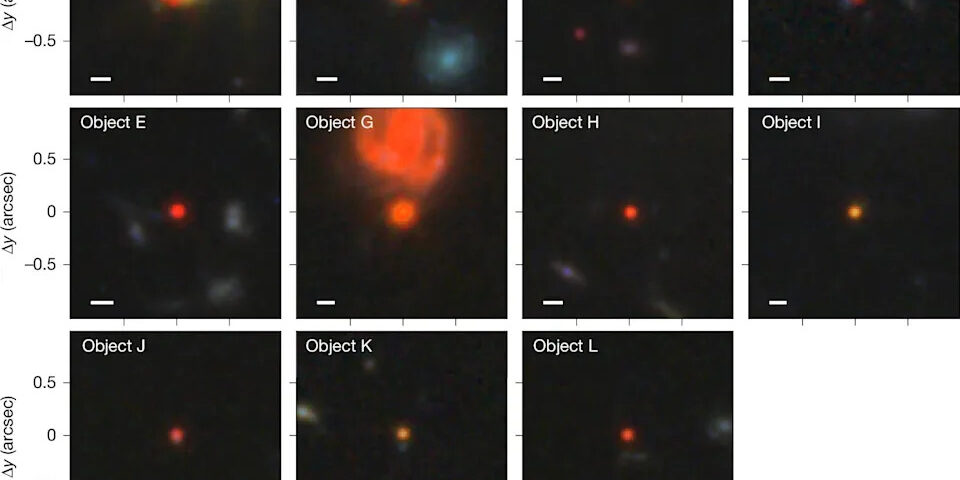
In December 2022, six months after the launch of the super-powerful Webb Telescope, the telescope spotted something previously unseen: countless small red objects in the sky, which NASA says scientists soon dubbed “little red dots” (LRDs).
A puzzle to astronomers, scientists theorised the LRDs could be very dense galaxies or supermassive black holes. “For a time, the LRDs were framed as breaking cosmology because they defied practically every expectation set by well-founded theories,” writes Lee Billings in Scientific American.
Black holes: NASA’s James Webb Space Telescope uncovers black hole secret
Advertisement
Advertisement
That is because the dots were “too massive and mature to be early galaxies brightened by swarms of newborn stars, yet they weren’t blasting out the x-rays and radio waves that are the hallmarks of supermassive black holes feeding on gas and dust,” he writes.
The LRDs were too dense to be galaxies because they couldn’t have formed that quickly – less than a billion years after the Big Bang, based on the Webb findings. But if they were black holes, they should be emitting X-rays and radio waves, but the Webb telescope wasn’t registering those from the LRDs.
The Webb telescope could see the “little red dots” at a time when “the universe was ‘only’ several hundred million years old, and a billion years later, they seem to disappear again,” says University of Copenhagen researchers who have an analysis of “little red dots,” published in the Jan. 15 issue of the journal Nature.
Researchers at the University of Copenhagen studied ‘little red dots’ captured by the Webb telescope and discovered they were young black holes each “enshrouded in a cocoon of gas.”
New research offers explanation for ‘little red dots’
Over two years, the researchers at the Niels Bohr Institute’s Cosmic Dawn Center studied a dozen LRDs to arrive at a possible explanation: The “little red dots” are young black holes; however, they are concealed by “a cocoon of gas, which they are consuming in order to grow larger,” said Darach Jafar Watson, an astrophysicist and one of the study’s principal researchers, in a description of the findings on the University of Copenhagen website.
Advertisement
Advertisement
As the surrounding gas is consumed, the black holes give off heat, which creates light that shines through the “cocoon,” Watson said. “This radiation through the cocoon is what gives little red dots their unique red colour.”
The LRDs “turned out to be supermassive black holes despite missing almost all typical indications of massive black holes,” study lead author Vadim Rusakov, who is now at the University of Manchester in England, told Space.com. “They have an almost perfect disguise that removes X-ray and radio emission.”
This explanation could resolve not only why LRDs perplexed scientists for so long, but also how they fit within current theories on the evolution of the universe.
“In astronomy, youth is usually associated with the colour blue, because young stars burn hot and blue. But here, the youngest supermassive black holes are red,” notes Rodrigo Nemmen, an astrophysicist at the University of São Paulo, Brazil, in a commentary on the research, also published in the Jan. 15 issue of Nature.
Advertisement
Advertisement
“It seems that the Universe has a sense of humour,” Nemmen writes.
Mike Snider is a national trending news reporter for USA TODAY. You can follow him on Threads, Bluesky, X and email him at mikegsnider & @mikegsnider.bsky.social & @mikesnider & [email protected].
This article originally appeared on USA TODAY: Black holes may be answer to space mystery of ‘little red dots’