This post was originally published on here
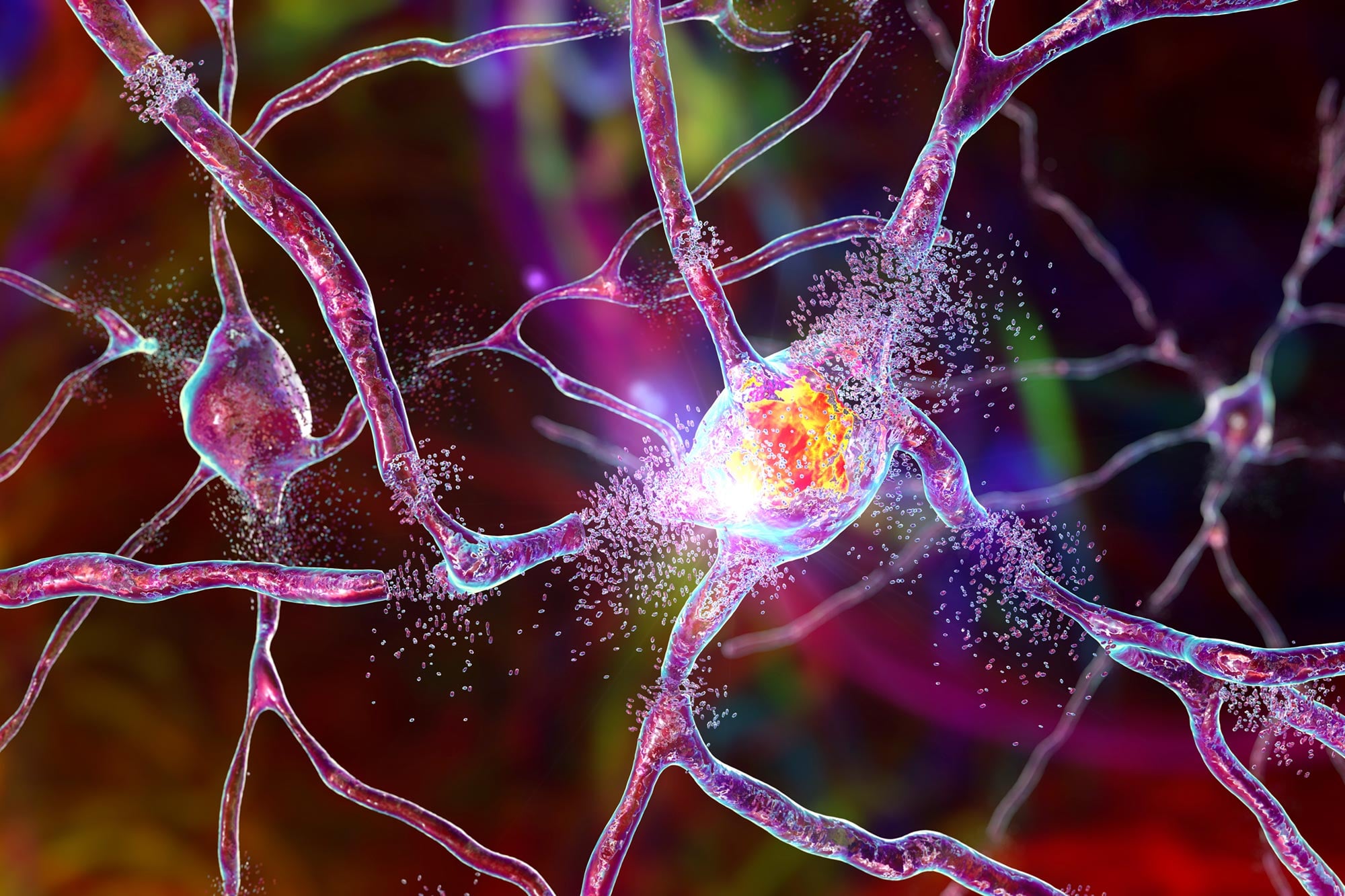
Scientists have identified the role of an ion channel that plays a key part in how cells break down and recycle components, a discovery that could open the door to new treatment strategies for Parkinson’s disease.
Washbowls, bathtubs, and sinks include an overflow that keeps water from spilling out. Researchers now report that cells appear to have a comparable safeguard inside their own recycling compartments.
The discovery comes from a new study by scientists at Bonn-Rhein-Sieg University of Applied Sciences (H-BRS), LMU Munich, TU Darmstadt, and the company Nanion Technologies, published in the Proceedings of the National Academy of Sciences.
Led by pharmacologist Professor Christian Grimm (LMU Munich) and Dr. Oliver Rauh (H-BRS), the team unraveled how the ion channel TMEM175 works, resolving a long-running debate. They found that in lysosomes, TMEM175 seems to function like an overflow valve that helps prevent the compartment from becoming too acidic.
Fine-tuning of acidity in lysosomes
Lysosomes are small, membrane-enclosed vesicles that act as recycling centers inside human cells by breaking down macromolecules into basic building blocks. For this process to run properly, lysosomes must maintain an acidic environment. Acidity is measured by pH, which reflects the concentration of protons (H+) in an aqueous solution. In general, a lower pH indicates a higher concentration of protons.
A transmembrane protein keeps lysosomes acidic by pumping protons into them. But maintaining the right pH also depends on additional proteins embedded in the lysosomal membrane. The PNAS study highlights TMEM175 as a key part of this control system.
The researchers suggest that in healthy cells, TMEM175’s valve-like behavior helps hold lysosomes at an optimal acidity, supporting efficient degradation. In contrast, patients with mutations in this ion channel may lose proper pH regulation. When acidity can no longer be controlled, protein breakdown in lysosomes is impaired, which can ultimately contribute to neuronal cell death.
Many studies in recent years have linked faulty lysosomal degradation to aging and to neurodegenerative diseases such as Parkinson’s. “Our study establishes that the ion channel TMEM175 plays a decisive role here,” says Dr. Oliver Rauh.
Channel protein TMEM175 conducts potassium ions and protons
For a long time, scientists did not know where TMEM175 was located in cells or what it did, which is reflected in its plain name. TMEM175 simply stands for transmembrane protein 175.
Interest in the channel has grown in recent years as evidence accumulated connecting it to several neurodegenerative diseases, particularly Parkinson’s. Multiple investigations have since shown clearly that TMEM175 is a lysosomal channel protein that allows ions to pass through the lysosomal membrane.
Even so, researchers have disagreed about whether TMEM175 mainly transports potassium ions or protons, and what those ion movements mean for lysosomes in healthy cells compared with diseased ones.
Specific pH sensor in interior of lysosome
“I’ve worked on many ion channels, and TMEM175 is by far the strangest of them all,” says Dr. Oliver Rauh, who moved from TU Darmstadt to H-BRS to work in the research collaboration CytoTransport. “When we started on the project around six years ago, it was assumed that TMEM175 was a potassium channel. Its function was completely unknown. We’ve now been able to demonstrate that TMEM175 not only conducts potassium ions, but also protons, and is thus directly involved in the regulation of pH – that is, the proton concentration – in the interior of lysosomes.”
“Most of the experiments were conducted using the patch clamp method”, explains Christian Grimm, expert for the lysosomal patch clamp technique, which allows the electrophysiological characterization of ion channels in lysosome membranes. In this way, the researchers showed that TMEM175 is able to recognize the critical pH status and adapt the flow of protons through the ion channel accordingly.
“Our findings create an important foundation for a better understanding of functional processes in lysosomes and the function of the TMEM175 channel, which was contested before now,” say the authors. “At the same time, our insights into the protein TMEM175 offer a promising target structure for the development of drugs to treat or prevent neurodegenerative diseases like Parkinson’s.”
Reference: “Proton-selective conductance and gating of the lysosomal cation channel TMEM175” by Tobias Schulze, Timon Sprave, Carolin Groebe, Jan Hendrik Krumbach, Magnus Behringer, Andre Bazzone, Rocco Zerlotti, Niels Fertig, Mike Althaus, Kay Hamacher, Gerhard Thiel, Christian Grimm and Oliver Rauh, 14 January 2026, Proceedings of the National Academy of Sciences.
DOI: 10.1073/pnas.2503909123
Never miss a breakthrough: Join the SciTechDaily newsletter.
Follow us on Google and Google News.