This post was originally published on here
A children’s science fair brought families to campus last Thursday evening for interactive demonstrations and outreach led by MSU science departments and community organizations.
The event featured a range of science activities designed to engage participants through touch, experimentation and conversation. Stations were hosted by educators, graduate students and representatives from MSU departments, as well as Montana PBS and the Museum of the Rockies (MOR).
One of the most popular booths, led by MOR Education Specialist MaggieJo Widdecombe, focused on fossils and geologic time.
The booth featured a colorful trivia wheel that introduced children to deep time and the history of life on Earth. The wheel allowed children to spin for a specific era in Earth’s history, which then connected to physical fossil examples.
“Paleontologists deal with time, just like geologists, so we thought, why not do geologic deep time trivia?” Widdecombe said. “Every number the wheel lands on corresponds to a different time period, and we bring out fossils — both casts and real specimens — that match that era,” she said.
The fossils ranged widely in age and type. “We have everything from relatively recent fossils like mammoths and mastodons, all the way back to some of the oldest life on Earth,” she said.
Ancient fossils were also on display. “This is one of my favorite things. It’s called a stromatolite, and it’s a 3 billion-year-old fossil,” Widdecombe said.
According to her, another item also captured children’s attention. “Honestly, my favorite fossil here is this one, fossil poop, or what’s known as a coprolite,” she said. “I love having kids hold it, and then asking them, ‘Do you know what you’re holding?’”
Widdecombe emphasized that events like this are an essential part of MOR’s education efforts. “We go all over the state to farmers’ markets, libraries, everything,” she said.
MSU’s Physics Department hosted a booth that allowed children to explore planetary science through touch. Student representative Katie Johnson described the display as a planetary petting zoo.
“We have a bunch of 3D models of the surface of both the moon and Mars so people can actually feel what’s going on,” Johnson said. “You can feel the craters on the moon from asteroid impacts.”
The Mars model included details of human expeditions to the planet. “We show where the Mars rover landed, and the full spheres give you an overview of the entire planet,” Johnson said. “You can see Olympus Mons, which is the biggest mountain in our solar system. It’s a volcano.”
In addition to models, the booth included material samples. “We also have samples of soil from the moon and Mars,” Johnson said.
She noted the collaborative nature of the event. “It’s all run through MSU, and most people here are either professors or students in different departments.”
Montana PBS hosted an activity focused on building simple flying toys. “We’re helping kids build bunny copters,” said Education Specialist Nikki Gradenberg.
“It’s connected to a PBS kids’ show that teaches science and environmental science. The activities are designed to make science hands-on and fun for kids,” Gradenberg said, adding that the booth also connected families with additional learning tools.
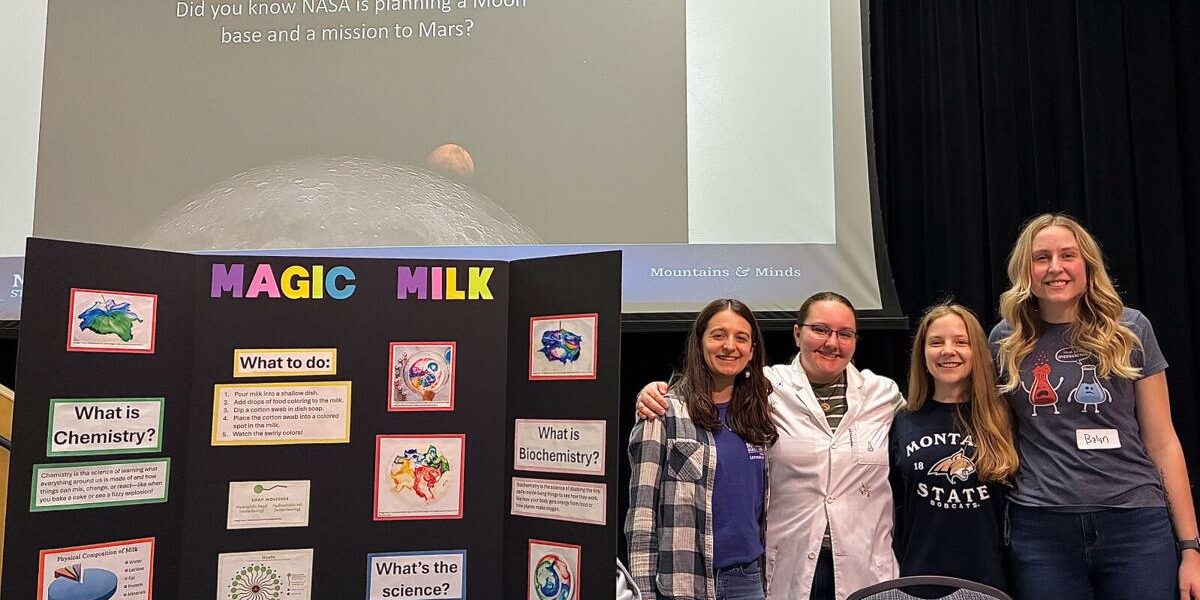
Graduate students from MSU’s Biochemistry Department led hands-on experiments and other activities. Additionally, its booth provided information on summer science programs for students.
“We’re all chemistry graduate students, some of us are working on PhDs in chemistry, and others are completing master’s degrees,” said student representative and master’s candidate Balyn Muffley.
She emphasized the importance of an early exposure to science. “We really love sparking interest in science in young minds,” she said. “It’s super important to get kids excited about science early on.”
Director of MSU’s Science Math Resource Center Suzi Taylor said her office had multiple booths at the fair, including MSU’s Applied Quantum CORE and its SMART FIRES project.
“Yes, we are teaching fifth graders about quantum physics,” she said.
Taylor discussed other outreach programs for students, such as NASA AEROKATS, which also participates in other science nights.
“NASA AEROKATS is so cool. We fly giant, beautiful kites with small cameras or scientific instruments to collect data for NASA,” she said.
The event previewed future science outreach, like the Science Olympiad, a national STEM competition, according to its website. “We’ll have more than 800 middle and high school students on campus,” Taylor said. “Many of them go on to become MSU students.”
Taylor highlighted the importance of providing these opportunities to students. “We send out a survey to coaches and teachers, asking them about their experience and if their students had ever visited a college campus,” she said.
For more information about upcoming science nights or volunteer opportunities, visit https://ato.montana.edu/outreach/.