This post was originally published on here
DENVER — Over the last two months, Colorado has experienced three controversial power shutoffs intended to protect communities against catastrophic wildfires. Xcel Energy’s decision to enact such measures has been met with backlash from those directly impacted by the planned outages.
Now, for the first time, Denver7 is getting an inside look at the meteorologists whose work informs the company’s decision to turn off power.
A Public Safety Power Shutoff (PSPS) occurs when there are extreme winds, low relative humidity, and very dry fuels.
The very first PSPS was implemented in April of 2024. There were two in December of 2025 in response to hurricane-strength winds whipping through the Front Range foothills, and another in January of this year across Larimer and Weld counties.
Denver7 has listened to frustration from community members about the planned power shutoffs, which representatives of Xcel Energy have repeatedly called a “last resort.”
Boulder City Council even decided to send a letter to Xcel Energy regarding “major concerns” it has with their partnership, one of which was connected to the power shutoffs.
The President of Xcel Energy – Colorado, Robert Kenney, told Colorado lawmakers during a joint committee hearing that the company is working to “improve the time, scope, and impact” of the power outages while becoming more precise when determining what parts of the grid they de-energize.
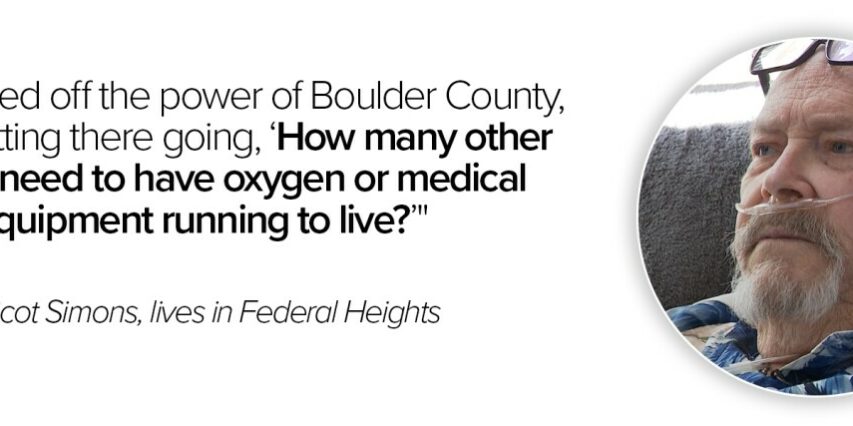
During that hearing, State Rep. Jenny Willford, D-District 34, spoke about the experience of one of her constituents who contacted her about the power shutoffs. Scot Simons, who depends on an oxygen machine, voiced his concerns to Willford about what would happen if power was turned off for people in a similar situation as his.
Denver7 met with Simons, who claimed he called Xcel Energy and told them the shutoffs could be dangerous to those who rely on medical equipment at home.
Simons claimed the person on the other end of the line told him to go to the emergency room during a shutoff.
“That’s not customer service, that’s being a bureaucrat,” Simons told Denver7.
When asked if he believes meteorologists who forecast the weather events can help justify the need for a PSPS, Simons acknowledged it will “assist” the company in those decisions, while continuing to say the power outages cannot be a long-term solution.
Enacting a PSPS is a challenging decision, according to the
Director of Wildfire Meteorology and Fire Science at Xcel Energy, Zach Tolby.
“This is being done for public safety,” Tolby said. “As we continue to get better models and better tools, we will be able to be more granular in the forecasting, but there are physical limits right now.”
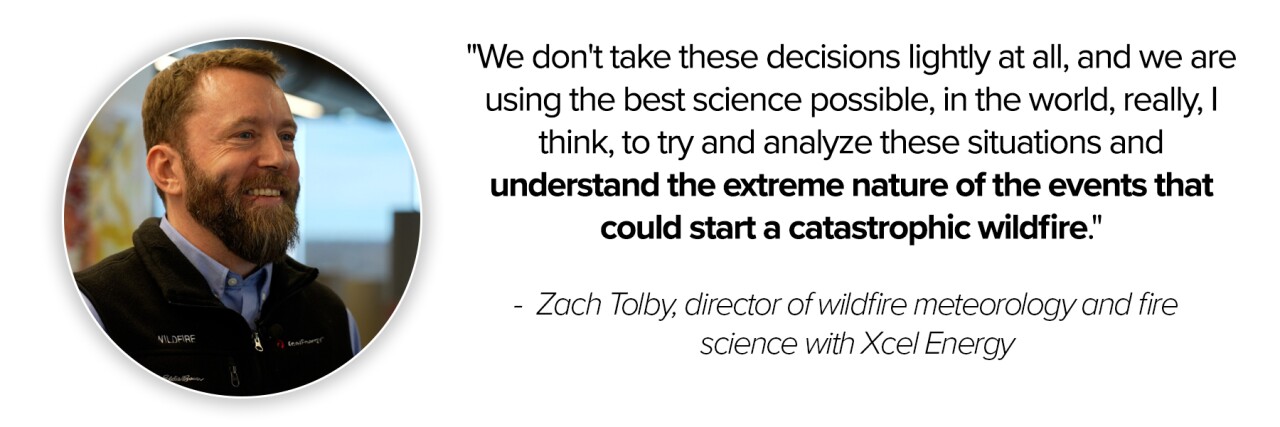
Tolby has worked with Xcel for a little more than six months, but has been a meteorologist for around 15 years. Previously, he worked for the National Oceanic and Atmospheric Administration (NOAA) and the National Weather Service (NWS).
“Nobody wants to have their power turned off,” Tolby said. “But in extreme circumstances, we can’t have any chance of starting a fire. Because in those kind of circumstances, firefighters can’t even fight the wildfire.”
Adding to the stress of such a decision are the extreme conditions facing Colorado this winter.
“There are large portions of Colorado that are in high to extreme drought,” Tolby said. “Since 1940, we’ve only seen two winters that were drier than this. So, there’s basically no snow below 10,000 feet right now, which is a very unusual circumstance that makes the chance for wildfire much higher than normal.”
There are 10 full-time members of the Wildfire Meteorology and Fire Science team at Xcel Energy — 11 including Tolby — who constantly monitor the weather. Denver7 was shown some of the models they use to do so, including one where they can simulate a fire in a certain location and see how the current conditions would impact that blaze.
State
Colorado lawmakers bombard Xcel Energy with questions about power shutoffs
Tolby said they are on the “edge of predictability” when it comes to this kind of science, making it both interesting and challenging.
“Unfortunately, downslope windstorms are really hard to predict, both in the timing but also in where they surface. It’s kind of like water rolling over a rock. You know that the water is going to roll over, but you don’t know exactly how the eddies and the wind is going to form on the back side of that,” Tolby said. “Predicting exactly where it’s going to be really windy, and where it’s going to be calm, is beyond our level of predictability at this point.”
As a meteorologist, Tolby does not make the call to issue a PSPS, but his team informs leadership at Xcel when there is the potential for a high wind event to align with dry fuels and low humidity.
“We’re constantly looking for the alignment of all of those factors. And then when we start to see that, then we bring the attention to the incident command system and to the leadership. And then that goes through a decision-making process and refinement,” Tolby said. “We also use tools and technology to try to refine exactly what power lines get turned off in the area that we’re concerned about.”
Tolby said the goal is to give the public as much time as possible to prepare, with forecasters working around the clock, seven days a week, in preparation of the worst case scenario.
“At this point, the evidence for climate change is overwhelming. The science that we’re doing and the recommendations that we’re making are, I hope, helping keep people safe in a changing climate,” Tolby said. “We don’t want there to be a mystery around this. It is very difficult decisions that Xcel makes in these circumstances. And I think understanding the science and understanding the process is important.”