This post was originally published on here
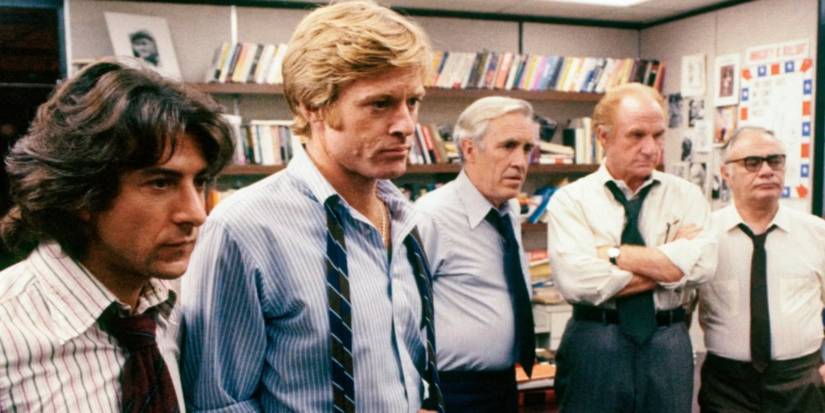
“The story of Watergate, when you boil it to its essence, is about the abuse of power by somebody in a position to exercise that power.” These are the cold words from White House Counsel to Richard Nixon, John Wesley Dean. President Richard Nixon’s 1972 re-election campaign was caught breaking into and installing wiretapping technology at the head of the Democratic National Committee in Washington, D.C. The organization was housed in the Watergate complex. Nixon’s allies worked to conceal the conspiracy, leading to the resignation of the President in 1974. Breaking the story for the nation was Washington Post reporters Carl Bernstein and Bob Woodward, whose subsequent book was made into the classic 1976 film All the President’s Men.
It’s been fifty years, but the film hasn’t aged a day. Stories of political corruption run rampant, and the crimes of Nixon’s team appear quaint in 2026. Still, at the heart of the story are two journalists determined to get to the facts of the conspiracy that included wiretapping political opponents, extortion, blackmail, and double-crosses. Nixon’s lust for power over his enemies — he didn’t see them as mere political opponents — was legion. The film stars the late Robert Redford as Bob Woodward and Dustin Hoffman as Carl Bernstein, two reporters who work tirelessly to fight through the fog of political disinformation to get to the bottom of the story: a true testament to quality journalism.
‘All the President’s Men’ Is Still a Masterpiece
Your browser does not support the video tag.
As Woodward and Bernstein, or as editor Ben Bradlee (Jason Robards) called them, ‘Woodstein’—track leads, they find myriad excuses still used by political criminals today. They were “just following orders,” the tales always begin. One Nixon attorney spoke about the process they called “Ratf*****,” where the goal was to shovel enough garbage at the opposition to destroy them by any means possible.
Cheating, character assassination, bogus lawsuits, everything was on the table. A key witness who did not go on the record and remained in ‘deep cover,’ was known as Deep Throat (another Ben Bradlee pun referencing the classic 1970s porno film). Deep Throat, played by Hal Holbrook, offered the timeless advice: “Follow the money.”
Woodstein followed the cash and was able to connect the Miami-based burglars to a $25,000 check paid by Nixon’s re-election campaign. The team responsible for breaking into the Watergate building was known as the White House Plumbers (the name and basis for the 2023 HBO series).
One of these plumbers, former FBI agent G. Gordon Liddy, is unmistakable for his Tom Selleck mustache, as well as those annoying 1990s TV ads force-feeding viewers about investing in gold. Liddy’s leadership of the Watergate burglars landed him a twenty-year prison sentence, of which he served five years.
What makes All the President’s Men so good after all of these years is the pacing. In an age of oversaturation with media and notifications, the film forces us to slow down and focus. Every detail had to be closely examined as it would be carefully scrutinized by the publisher. Nothing was going to make the front page unless Bradlee was convinced of its authenticity.
The Nixon committee’s dedication to “Ratf******” was embraced by political operators like Roger Stone, who worked with Nixon in 1972 and has remained a close advisor and supporter of President Trump. Disgusting political tactics are seen across the spectrum, but the Republican brand of seek and destroy has found its way in and out of the civic landscape for decades.
All the President’s Men gives us a glimpse of the past while offering an easy parallel to our current culture.
Director Alan Pakula may not be a household name, but he has an incredible resume beyond All the President’s Men, including Klute, The Parallax View, Sophie’s Choice, The Pelican Brief, and The Devil’s Own. He also served as a producer on To Kill a Mockingbird. All projects that deal with political ramifications of corruption, hatred, violence, prejudice, etc. All the President’s Men, on its fiftieth anniversary, feels both like a time capsule and a timeless work of art. The 4K restoration released by Warner Bros. is beautiful while maintaining the iconic feel of the many great 1970s political thrillers.
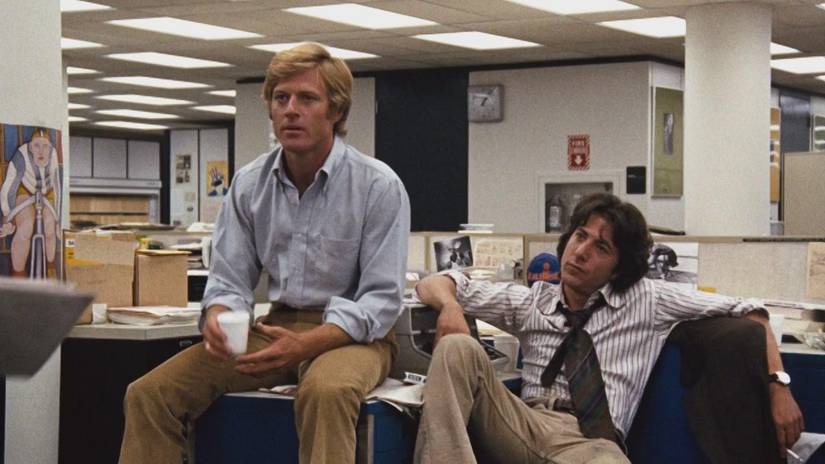
The film’s closing scene is permanently haunting. As we see Woodward and Bernstein typing away at their desks, a nearby TV plays Richard Nixon giving his oath of office, promising to uphold the Constitution, while we all know he was doing nothing of the sort. We don’t see the aftermath of the news story because we know what happened, especially for viewers in 1976.
The final frames are a reminder of the importance of speaking truth to power, regardless of who holds that power. It wasn’t long before the Watergate scandal that the Washington Post published details about the Pentagon that shed light on the government’s effort to lie about the Vietnam War. In the process of publishing that investigation, Bradlee and Washington Post publisher Katharine Graham turned a number of friends into enemies.
While All the President’s Men remains incredibly prescient in 2026, the last decade has given us a wealth of great films about the importance of journalism. Movies like Spotlight, The Post, and Civil War give us a range of perspectives on how journalism operates locally and nationally in times of crisis.
A film like Nightcrawler offers a pessimistic perspective on the old adage: “If it bleeds, it leads.” Years of political turmoil not only call on courageous journalists but also on fearless filmmakers to bring such stories to the big screen. All the President’s Men has been the benchmark for half a century and will remain the basis of comparison for another fifty years.